Geographical Situation
Cordoba province, one of the eight which make up Andalusia, covers an area of 13, 723, 20 square kilometres, representing 2.7% of the surface area of Spain as a whole. This makes Cordoba the second largest province in Andalusia and the thirteenth largest in Spain. Its border stretches for 696 kilometres and is shared with six other provinces (with Badajoz and Ciudad Real to the north, with Jaen to the east, with Granada and Malaga to the south, and with Seville and Badajoz to the west). It can be found between 38 44´ and 37 11´ degrees latitude at its most northerly and southerly points, and between 0 19´and 1 54´ degrees longitude (relative to the Madrid meridian) at its most easterly and westerly most points respectively.
The capital Cordoba can be found at 37 50´44” degrees latitude and 04 50´23” longitude, at an average of 123m above sea level.
The entire province can be found below 1,000m above sea level, with the largest section being between 200m and 600m and spanning 8,556 square kilometres, followed by 3,378 square kilometres of land between 600m and 1000m of altitude, with the remaining 1,784 square kilometres found below 200m and mainly consisting of the fertile plains which line the banks of the Guadalquivir River.
The province is carved into two by the Guadalquivir River which runs from east to west. Despite the two areas being almost equal in size, they are quite different in geographical and agricultural terms. The part to the north of the river takes in the mountainous Sierra Morena and a plateau which stretches down to the Guadalquivir, with both areas being used primarily for large-scale cattle farming. The land to the south of the river is dominated by the Campiña plain, which stretches throughout the South-West towards Seville, and is superbly suited for agriculture. Finally, the Penibetic zone is the area closest to the meridian and is where olive groves and vines can be found in abundance. The hydrographical conditions are relatively good, given that as well as the Guadalquivir there are four other reasonably sized rivers flowing within the province’s boundaries, even when the lie of the land does not particularly favour successful agriculture.
How to get there
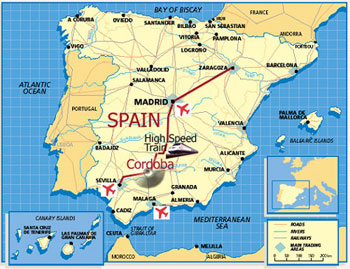
Cordoba lies on the route that links Madrid with Andalusia as part of Spain’s radial trunk road system, and is also connected to the roads linking the South East and South West of the peninsula. This means that the capital Cordoba lies on a crossroads of motorways, being crossed by the radial IV Madrid – Cadiz which is one of the largest thoroughfares in the peninsula, as well as by the national motorway linking Badajoz and Granada. In addition to this, the national motorway connecting Malaga and the Costa del Sol with the national trunk road system begins on the outskirts of the capital, as well as the national motorways which lead to Jaen to the east and Puertollano and Ciudad Real to the north.
The best way to get to the city of Cordoba is by high-speed train from the city of Madrid (1 hour and 40 minutes) or from the city of Seville (40 minutes). There is also a train link between Malaga and Cordoba which takes just 2 hours.
You can find information about how to get to Cordoba on the web page of the Spanish Rail Company (www.renfe.es) or the web page of our travel agents (www.viajescajasur.com).
Passenger flights do not go to the city of Cordoba.
Climate
Cordoba’s climate is conditioned by both atmospheric phenomena as well as by the physical characteristics of the surrounding area.
The city is orographically hemmed in from the north by the Sierra Morena, while being wide open through east to west through the Guadalquivir valley, and stretches towards the south in the shape of the miocenic Campiña plain. Its climate could be considered Mediterranean, but in fact it has all the characteristics of a continental climate, generated by the city’s own particular microclimate.
The masses of humid air proceeding from the Atlantic find their progress blocked by the orographic barrier of the Sierra Morena, loosing their rainfall on the windward hillside as they struggle their way through. By the time they arrive in the capital Cordoba all their humidity has disappeared. That is to say, the Sierra Morena forms an imposing physical barrier preventing the fall of rain heading over from the Atlantic.
In fact it is the Guadalquivir Valley that ensures rain falls in the capital. The masses of warm air coming from North Africa have no obstacle in their way as they flow from the Gulf of Cadiz to Cordoba, picking up all their humidity from the ocean along the way, turning into masses of warm and humid air. This is why, when they release their load, the rainfall is continual and heavy.
This is how Cordoba gets its first rainy period that usually takes place between the seasons of autumn and spring.
In spite of all this, the climate in Cordoba is typified by a series of precipitations linked to the northern latitudes, and is heavily influenced by the African continent.
The influence of the great land mass that is Africa makes Cordoba a city of strikingly contrasting climate changes. In this way, in the winter months the temperatures often do not rise above zero degrees Celsius, and we can also see summers with temperatures in excess of 45 degrees.
Another factor to be considered is the considerable amount of sunshine enjoyed by the capital Cordoba, which experiences an average of 143 clear days a year as opposed to just 76 overcast days.
At the same time the city itself intrinsically generates an urban microclimate; that is to say, one that is controlled by its buildings and structures, the materials with which these are constructed and the characteristics of the thoroughfares where they are built.
We can therefore safely draw the conclusion that the climate in Cordoba is characterized by extreme temperatures and a certain amount of rainfall in winter, which can cause widespread frosting thanks to the sheer cold. Spring and autumn usually experience some rain while summer is a torrid season in Cordoba with extremely high temperatures and the threat of storms at the end of each day.
|